Handpan
A handpan in your phone: play it, loop it and build a beat
A 9-note D Kurd handpan with Ding, edge and double hits on 16 pads. Play it with your thumbs, record it in layers and build a beat around it.
- 9 real notes in the D minor scale: hard to hit a wrong one
- Ding, edge, 4 double hits and 2 runs on 16 pads
- 3 Ready beats, 3 Ready songs and 15 Random Beats in D minor
With PadLoop you play a handpan on your phone: 9 real notes of a D Kurd on 16 pads, from the Ding to the edge to the double hits. The notes all sit in the D minor scale, so they don’t clash. Then record the loop in layers, or load a Ready beat with the handpan and play over it. The Handpan is a full-PadLoop plugin: you can try it, along with everything else, during the 7-day trial.
The Handpan lo-fi beat is loaded, the handpan is played on the Keyboard and one loop is recorded over the beat.
From plugin to first loop
- In MORE, tap Plugins and download Handpan (2.3 MB) in the Instruments section.
- In the PAD tab, tap ⊞ (the menu of banks and Ready beats), open the Ready banks and pick Handpan (D Kurd): you get 16 pads ready to play.
- Play: pad 1 is the Ding, the other eight are the notes around it.
- Press REC and play one loop. Recording keeps going loop after loop: tap REC again to close it.
- Record a second layer on a new track (the numbers at the top: each number is a layer of the piece), or load a Ready beat with the handpan first and play over it.
Play the Ding and record your first handpan loop: the Handpan plugin and the Ready beats that use it are open for the 7-day trial.On iPhone: in MORE tap the top row, then Start the free trial. It costs nothing and does not renew.
Get PadLoopNine notes, none out of tune
D Kurd is one of the most common handpan tunings: every note sits in the D minor scale. There are nine, from lowest to highest:
- D3 (the Ding, the low note in the middle), A3, B♭3
- C4, D4, E4, F4, G4, A4
In practice: play the notes in any order and the loop sounds good. That’s why a handpan suits people who have never played an instrument. The sound is recorded by PadLoop, one note at a time. Where a note is missing, the Keyboard uses the closest recording.
What’s on the 16 pads
A bank is a page of 16 pads. The handpan bank reads like this:
- Pads 1-9: the nine notes, with the Ding on pad 1
- Pad 10: the Ding’s edge, the hit on the rim of the low note
- Pads 11-14: four double hits (two notes together): G4 + A4, C4 + D4, D4 + E4 and C4 + A4
- Pads 15-16: two quick runs, from D4 to A4 and from E4 to A4
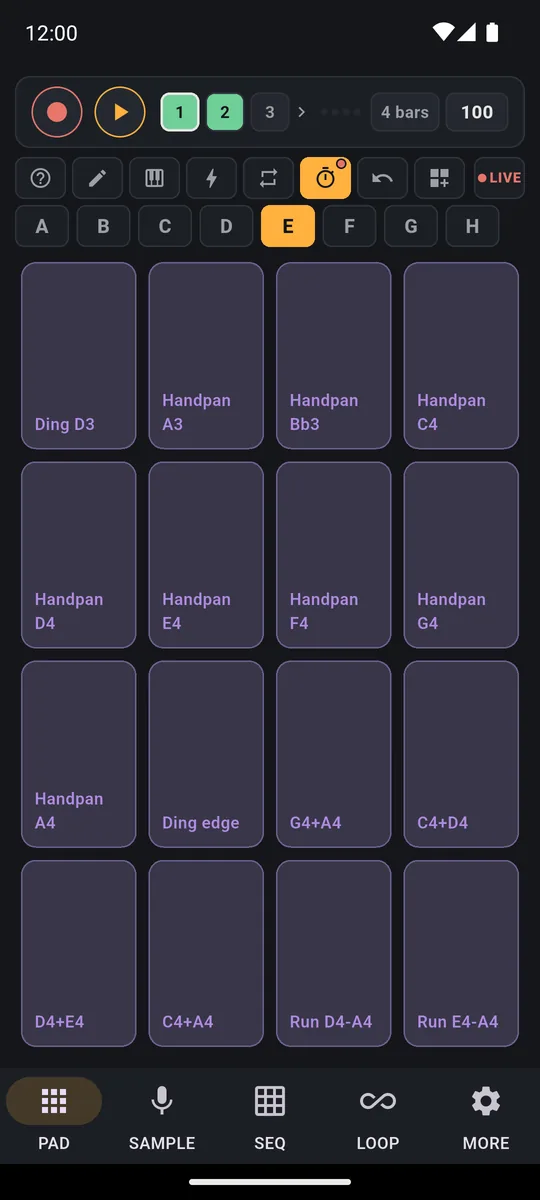
The Handpan (D Kurd) bank: the Ding on pad 1, the notes around it, the edge, the double hits and the two runs.
The double hits and runs give you in one tap what takes two fingers on a real handpan. With the pencil (the button that edits pads) you can also adjust each pad’s volume and effects.
Play it on the Keyboard
The Keyboard (the piano button) turns the 16 pads into a row of notes from lowest to highest. The Handpan is one of the instruments you play this way, with its real notes. Pick the Minor scale and D as the root (with ◄ ►): every key is in the right scale, and the cells show the real note names, like “D4”. ▼ ▲ moves everything up or down an octave.
Try ⟳ (it repeats the hit in time): with the Arpeggio row on Up/Down, the handpan plays a cascade of notes on its own while you hold down two or three keys. With 📌 Latch the notes keep going after you lift your finger. The Keyboard is explained in more detail on the page about playing in key.
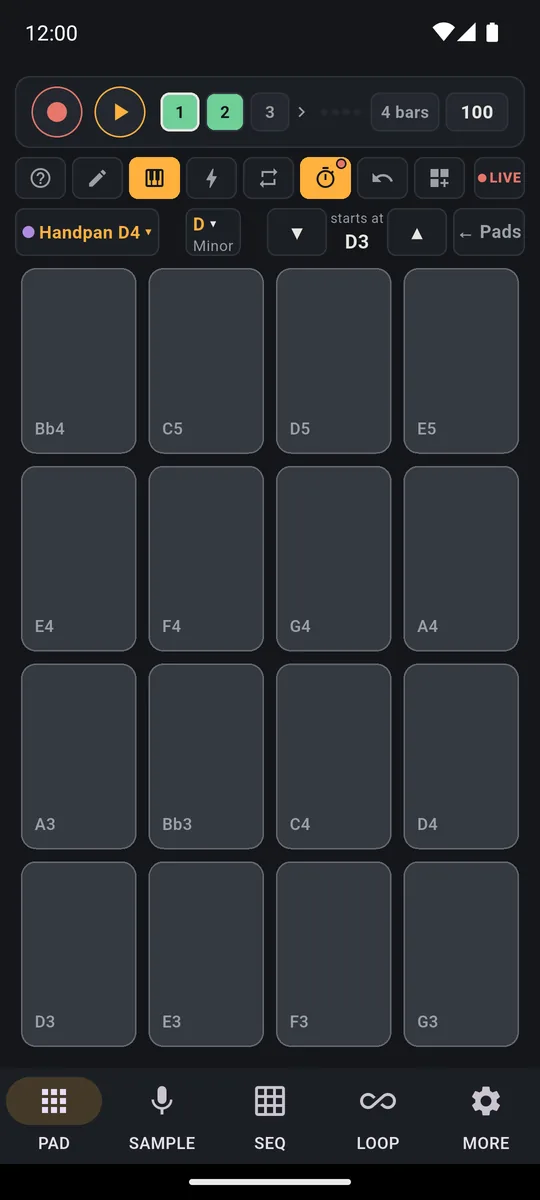
The Keyboard on the handpan, in D minor, with note names on the cells.
A three-layer handpan loop
A 4-bar loop (a bar is a group of four beats: 1, 2, 3, 4) is enough for a whole piece:
- Layer 1, the base. Play the Ding on 1 and A3 or B♭3 on 3, softly, with the edge in between now and then. The loop breathes and stays wide.
- Layer 2, the melody. On a new track, play D4, E4, F4 and A4 in a pattern you repeat: your right hand is enough.
- Layer 3, the color. A double hit at the end of the loop, or a run on pad 15 before it starts over. Don’t like it? ↶ Undo last layer takes it off so you can try again.
Add some Reverb from the bolt (the effects you hold down) and the sound opens up. Then put a slow kick under it, or leave it alone.
Beats, songs and Random Beats with the handpan
The handpan comes with some ready-made music, all in D minor, like its D Kurd:
- 3 Ready beats: Handpan lo-fi (86 BPM), Handpan afro chill (107 BPM) and Handpan & percussion (89 BPM). BPM is the speed, in beats per minute. A Ready beat loads banks and tracks already recorded, and you play the notes over it: see the Ready beats.
- 3 Ready songs, one each in the Afro & Amapiano, House & Disco and Lo-fi & Boom bap packs, with Intro, Verse and Drop: read about the ready-made songs.
- 15 Random Beats: five lo-fi, five afrobeats and five house, in the beat generator.
Online handpan or the handpan in the app?
The site also has a free online handpan you play in the browser: great for messing around and hearing what it sounds like. This is something else: the handpan becomes an instrument inside your project. You loop it, put it over a beat, repeat it with the arpeggio, combine it with drums or percussion and make a video of it. If you only want to try the notes, use the online one; if you want a track, use PadLoop.
What’s free and what isn’t
The Handpan is a full-PadLoop plugin: you download it during the 7-day trial or with the one-time unlock, and the same goes for the three Ready beats and Random Beat. Don’t count on it in the free version: the Handpan bank loads onto a bank from D to H (a single sound placed by hand, onto C to H), and those banks open with the purchase. Banks A and B, 2 looper tracks and the Keyboard on A and B sounds stay free forever. Prices are in pricing and FAQ.
Good to know
- You download it once. The plugin is 2.3 MB and then works without internet.
- Nine real notes, sixteen pads. Nine notes are recorded: the other pads are the edge, the double hits and the runs.
- Where it goes. During the 7-day trial, the Handpan bank loads onto a bank from D to H, which you pick.
- One tuning only. It’s a D Kurd: if you need another scale, pick another instrument among the plugins.
Load Handpan lo-fi and play D minor notes over it: none of them clashes, and the 7-day trial lets you try everything.On iPhone: in MORE tap the top row, then Start the free trial. It costs nothing and does not renew.
Get PadLoopQuestions about the handpan in PadLoop
Is there a handpan app for Android and iPhone?
Yes. In PadLoop the Handpan is an instrument you download inside the app: 9 real notes of a D Kurd, recorded by PadLoop, on 16 pads. You play it, loop it and build a beat around it. It works on Android and on iPhone.
What scale does PadLoop’s handpan have?
D Kurd with 9 notes: D3, A3, B♭3, C4, D4, E4, F4, G4 and A4, with the Ding on D3. They’re all notes of the D minor scale, so you can play them in any order.
What’s on the 16 pads?
Pads 1-9 are the nine notes (pad 1 is the Ding). Pad 10 is the Ding’s edge, pads 11-14 are four double hits and pads 15-16 are two quick runs.
Can I play it on the Keyboard?
Yes: the Handpan is a Keyboard instrument. Open the Keyboard, pick Handpan and set the Minor scale with D as the root: all 16 keys are already in the right scale.
Are there Ready beats with the handpan?
Three Ready beats: Handpan lo-fi (86 BPM), Handpan afro chill (107 BPM) and Handpan & percussion (89 BPM). Plus 3 Ready songs and 15 Random Beats (lo-fi, afrobeats and house), all in D minor.
Is the handpan free in PadLoop?
It’s a full-PadLoop plugin: download and use it during the 7-day trial, then keep it with the one-time unlock. During the trial the Handpan bank loads onto a bank from D to H (a single handpan sound you place by hand, onto C to H): after the trial those banks open with the purchase.
How is it different from the online handpan on this site?
The online handpan plays in your browser, free, to mess around. PadLoop’s handpan lives inside the app: you loop it, put it over a beat, play it on the Keyboard and build a track.
Does it need internet?
Only once, to download the Handpan plugin (2.3 MB). After that you play and record offline.
Last updated: